Mirror. This is an unmodified copy of nomic-ai/nomic-embed-text-v1.5 at commit e9b6763023c6, mirrored by Hippius on 2026-10-29. Large files were checked against Hugging Face's published SHA-256 before upload (1 verified). License: apache-2.0. All credit to the original authors.
nomic-embed-text-v1.5: Resizable Production Embeddings with Matryoshka Representation Learning
Blog | Technical Report | AWS SageMaker | Nomic Platform
Exciting Update!: nomic-embed-text-v1.5 is now multimodal! nomic-embed-vision-v1.5 is aligned to the embedding space of nomic-embed-text-v1.5, meaning any text embedding is multimodal!
Usage
Important: the text prompt must include a task instruction prefix, instructing the model which task is being performed.
For example, if you are implementing a RAG application, you embed your documents as search_document: <text here> and embed your user queries as search_query: <text here>.
Notice: From transformers v5.5.0 and sentence transformers v5.3.0, trust_remote_code=True will no longer be necessary. This will only be possible with the text-only series as of now.
Task instruction prefixes
search_document
Purpose: embed texts as documents from a dataset
This prefix is used for embedding texts as documents, for example as documents for a RAG index.
from sentence_transformers import SentenceTransformer

model = SentenceTransformer("nomic-ai/nomic-embed-text-v1.5")
sentences = ['search_document: TSNE is a dimensionality reduction algorithm created by Laurens van Der Maaten']
embeddings = model.encode(sentences)
print(embeddings)
search_query
Purpose: embed texts as questions to answer
This prefix is used for embedding texts as questions that documents from a dataset could resolve, for example as queries to be answered by a RAG application.
from sentence_transformers import SentenceTransformer

model = SentenceTransformer("nomic-ai/nomic-embed-text-v1.5")
sentences = ['search_query: Who is Laurens van Der Maaten?']
embeddings = model.encode(sentences)
print(embeddings)
clustering
Purpose: embed texts to group them into clusters
This prefix is used for embedding texts in order to group them into clusters, discover common topics, or remove semantic duplicates.
from sentence_transformers import SentenceTransformer

model = SentenceTransformer("nomic-ai/nomic-embed-text-v1.5")
sentences = ['clustering: the quick brown fox']
embeddings = model.encode(sentences)
print(embeddings)
classification
Purpose: embed texts to classify them
This prefix is used for embedding texts into vectors that will be used as features for a classification model
from sentence_transformers import SentenceTransformer

model = SentenceTransformer("nomic-ai/nomic-embed-text-v1.5")
sentences = ['classification: the quick brown fox']
embeddings = model.encode(sentences)
print(embeddings)
Sentence Transformers
import torch.nn.functional as F
from sentence_transformers import SentenceTransformer

matryoshka_dim = 512

model = SentenceTransformer("nomic-ai/nomic-embed-text-v1.5")
sentences = ['search_query: What is TSNE?', 'search_query: Who is Laurens van der Maaten?']
embeddings = model.encode(sentences, convert_to_tensor=True)
embeddings = F.layer_norm(embeddings, normalized_shape=(embeddings.shape[1],))
embeddings = embeddings[:, :matryoshka_dim]
embeddings = F.normalize(embeddings, p=2, dim=1)
print(embeddings)
Transformers
import torch
import torch.nn.functional as F
from transformers import AutoTokenizer, AutoModel

def mean_pooling(model_output, attention_mask):
    token_embeddings = model_output[0]
    input_mask_expanded = attention_mask.unsqueeze(-1).expand(token_embeddings.size()).float()
    return torch.sum(token_embeddings * input_mask_expanded, 1) / torch.clamp(input_mask_expanded.sum(1), min=1e-9)

sentences = ['search_query: What is TSNE?', 'search_query: Who is Laurens van der Maaten?']

tokenizer = AutoTokenizer.from_pretrained('bert-base-uncased')
model = AutoModel.from_pretrained('nomic-ai/nomic-embed-text-v1.5')
model.eval()

encoded_input = tokenizer(sentences, padding=True, truncation=True, return_tensors='pt')

+ matryoshka_dim = 512

with torch.no_grad():
    model_output = model(**encoded_input)

embeddings = mean_pooling(model_output, encoded_input['attention_mask'])
+ embeddings = F.layer_norm(embeddings, normalized_shape=(embeddings.shape[1],))
+ embeddings = embeddings[:, :matryoshka_dim]
embeddings = F.normalize(embeddings, p=2, dim=1)
print(embeddings)
The model natively supports scaling of the sequence length past 2048 tokens. To do so,
- tokenizer = AutoTokenizer.from_pretrained('bert-base-uncased')
+ tokenizer = AutoTokenizer.from_pretrained('bert-base-uncased', model_max_length=8192)

- model = AutoModel.from_pretrained('nomic-ai/nomic-embed-text-v1.5')
+ rope_parameters = {"rope_theta": 1000.0, "rope_type": "dynamic", "factor": 2.0}
+ model = AutoModel.from_pretrained('nomic-ai/nomic-embed-text-v1.5', rope_parameters=rope_parameters)
Transformers.js
import { pipeline, layer_norm } from '@huggingface/transformers';

// Create a feature extraction pipeline
const extractor = await pipeline('feature-extraction', 'nomic-ai/nomic-embed-text-v1.5');

// Define sentences
const texts = ['search_query: What is TSNE?', 'search_query: Who is Laurens van der Maaten?'];

// Compute sentence embeddings
let embeddings = await extractor(texts, { pooling: 'mean' });
console.log(embeddings); // Tensor of shape [2, 768]

const matryoshka_dim = 512;
embeddings = layer_norm(embeddings, [embeddings.dims[1]])
    .slice(null, [0, matryoshka_dim])
    .normalize(2, -1);
console.log(embeddings.tolist());
Nomic API
The easiest way to use Nomic Embed is through the Nomic Embedding API.
Generating embeddings with the nomic Python client is as easy as
from nomic import embed

output = embed.text(
    texts=['Nomic Embedding API', '#keepAIOpen'],
    model='nomic-embed-text-v1.5',
    task_type='search_document',
    dimensionality=256,
)

print(output)
For more information, see the API reference
Infinity
Usage with Infinity.
docker run --gpus all -v $PWD/data:/app/.cache -e HF_TOKEN=$HF_TOKEN -p "7997":"7997" \
michaelf34/infinity:0.0.70 \
v2 --model-id nomic-ai/nomic-embed-text-v1.5 --revision "main" --dtype float16 --batch-size 8 --engine torch --port 7997 --no-bettertransformer
Adjusting Dimensionality
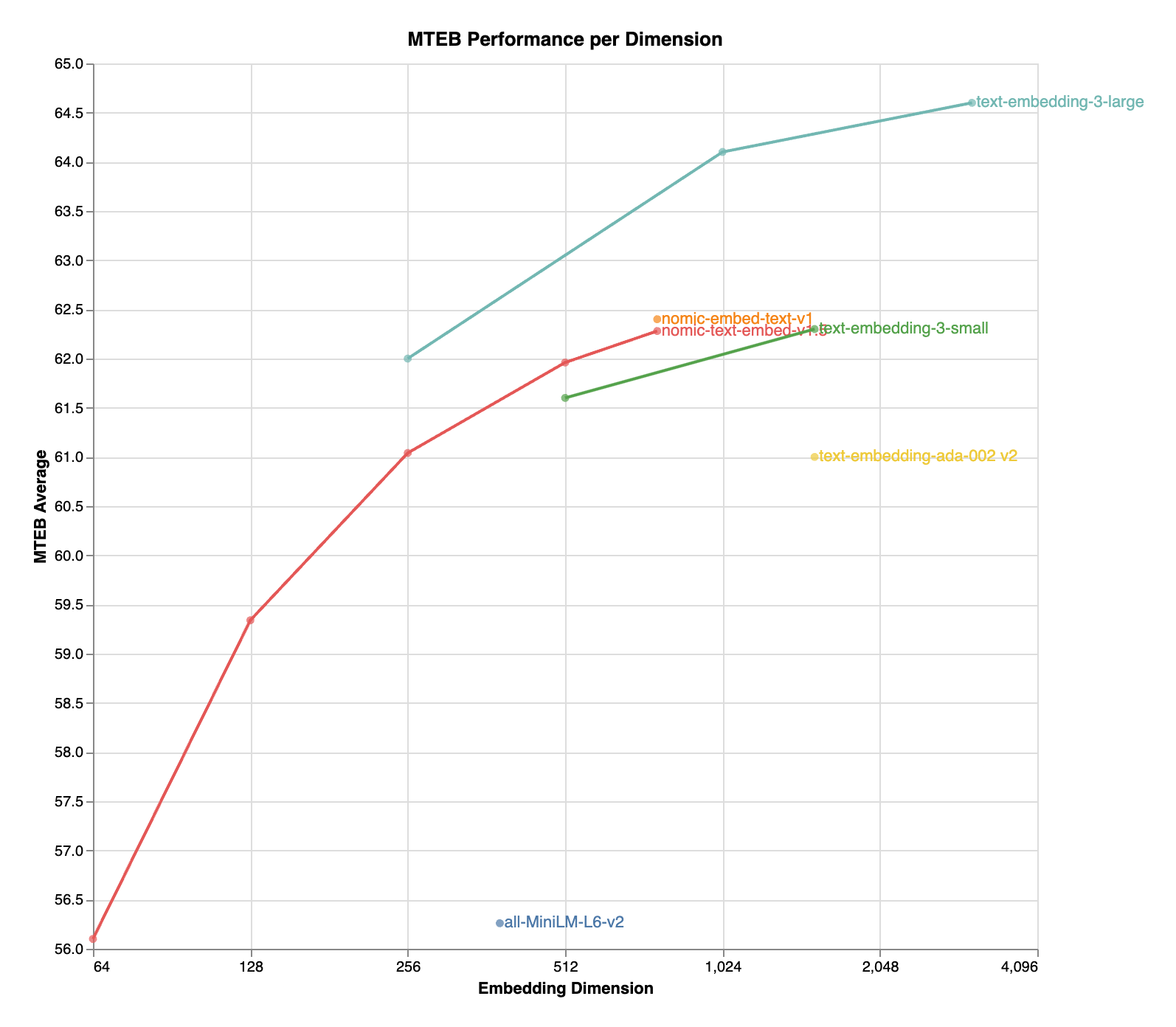
nomic-embed-text-v1.5 is an improvement upon Nomic Embed that utilizes Matryoshka Representation Learning which gives developers the flexibility to trade off the embedding size for a negligible reduction in performance.
| Name | SeqLen | Dimension | MTEB |
|---|---|---|---|
| nomic-embed-text-v1 | 8192 | 768 | 62.39 |
| nomic-embed-text-v1.5 | 8192 | 768 | 62.28 |
| nomic-embed-text-v1.5 | 8192 | 512 | 61.96 |
| nomic-embed-text-v1.5 | 8192 | 256 | 61.04 |
| nomic-embed-text-v1.5 | 8192 | 128 | 59.34 |
| nomic-embed-text-v1.5 | 8192 | 64 | 56.10 |
Training
Click the Nomic Atlas map below to visualize a 5M sample of our contrastive pretraining data!

We train our embedder using a multi-stage training pipeline. Starting from a long-context BERT model, the first unsupervised contrastive stage trains on a dataset generated from weakly related text pairs, such as question-answer pairs from forums like StackExchange and Quora, title-body pairs from Amazon reviews, and summarizations from news articles.
In the second finetuning stage, higher quality labeled datasets such as search queries and answers from web searches are leveraged. Data curation and hard-example mining is crucial in this stage.
For more details, see the Nomic Embed Technical Report and corresponding blog post.
Training data to train the models is released in its entirety. For more details, see the contrastors repository
Join the Nomic Community
- Nomic: https://nomic.ai
- Discord: https://discord.gg/myY5YDR8z8
- Twitter: https://twitter.com/nomic_ai
Citation
If you find the model, dataset, or training code useful, please cite our work
@misc{nussbaum2024nomic,
      title={Nomic Embed: Training a Reproducible Long Context Text Embedder},
      author={Zach Nussbaum and John X. Morris and Brandon Duderstadt and Andriy Mulyar},
      year={2024},
      eprint={2402.01613},
      archivePrefix={arXiv},
      primaryClass={cs.CL}
}